

Handmade Duck Down Pillows Made in Canada: 2026 Guide
Table of Contents
- Why Handmade Duck Down Pillows Made in Canada Stand Apart
- Fill Power and Loft: What the Numbers Actually Tell You
- Duck Down vs. Goose Down: Which Fill Belongs on Your Bed
- 50% Duck Down 50% Duck Feather Pillow Benefits
- How to Clean Down Pillows Without Flattening the Loft
- Matching Fill and Firmness to Your Sleeping Position
- Allergy Management, Dust Mites, and Sourcing Standards
- Conclusion
- Frequently Asked Questions
Last Updated: September 18, 2026
Why Handmade Duck Down Pillows Made in Canada Stand Apart
Handmade duck down pillows made in Canada offer a level of construction and material traceability that mass-produced imports can’t match. This guide from Best Sleep Centre explains what separates them, how fill power and loft work, and how to choose the right pillow for your sleeping position.

Handmade pillows are different in ways you can feel within a week. Seams are double-stitched, fill is weighed by hand, and the down is washed repeatedly before it ever reaches a shell. Our fills are washed 5 times.
The result is a pillow that is Clean of all dander, which is what ppl can be allergic too, holds its conformable shape, breathes better, and can be adjusted as your needs change. That last point matters more than most buyers expect. A handmade pillow can be re-fluffed, spot-cleaned, and in some cases re-stuffed.
Fill Power and Loft: What the Numbers Actually Tell You
Fill power measures how much space one ounce of down occupies, expressed in cubic inches. A fill power of 550 means one ounce of that down lofts to 550 cubic inches under standardized testing. Higher fill power means larger, stronger down clusters that trap more air per gram, and that translates directly into warmth, resilience, and how long the pillow holds its shape.
Loft is the visible height of the pillow once it settles. Fill power and loft are related but not identical. A high fill power pillow can still feel flat if too little fill is used for the shell size. This is the single most misunderstood point in down bedding: fill power describes the quality of the clusters, while fill weight describes how much of that down is actually inside the pillow. A 700 fill power pillow stuffed with 12 ounces will feel very different from the same shell stuffed with 20 ounces.
For most sleepers, a fill power in the 550-650 range balances support and softness. Very high fill power (700+) suits people who want a lighter, airier pillow. Lower fill power with more fill weight produces a denser, firmer feel, which is often what side sleepers actually need.
Down cluster quality matters more than the fill power number alone. Clusters with broken quills or excessive feather content compress faster and lose resilience within months. When you press a pillow and release it, quality clusters spring back within a second or two. If the pillow stays compressed, the cluster structure is already breaking down.
Here is how to read the numbers in practice:
Metric |
What It Tells You |
What It Does Not Tell You |
|---|---|---|
Fill power (cubic inches per ounce) |
Cluster size and quality |
How much fill is in the pillow |
Fill weight (ounces) |
Total down inside the shell |
Cluster quality |
Loft (inches) |
Finished height after settling |
How it will feel under your head |
Down-to-feather ratio |
Support vs. softness balance |
Washing and grading quality |
A common pattern is that two pillows with identical fill power ratings feel completely different because one uses 15 ounces of fill and the other uses 22. When comparing pillows, ask for both numbers. If a product page lists fill power but not fill weight, that is a signal the manufacturer is leaning on the more flattering number.
For a handmade pillow, the fill is weighed by hand, which means the fill weight on the label is closer to what is actually in the shell.
Duck Down vs. Goose Down: Which Fill Belongs on Your Bed
Goose down generally has larger clusters and higher fill power than duck down. Duck down clusters are smaller but still provide excellent loft, warmth, and resilience.
For most sleepers, the practical difference is minor. Duck down offers strong value, especially in a 50/50 blend with duck feathers, where the feathers add structure and support.
Goose down makes sense if you want the lightest possible pillow with maximum loft.
50% Duck Down 50% Duck Feather Pillow Benefits
A 50% duck down 50% duck feather pillow benefits sleepers who want the softness of down with the support and durability of feathers. The down provides loft and breathability, while the feathers add structure that keeps the pillow from collapsing.
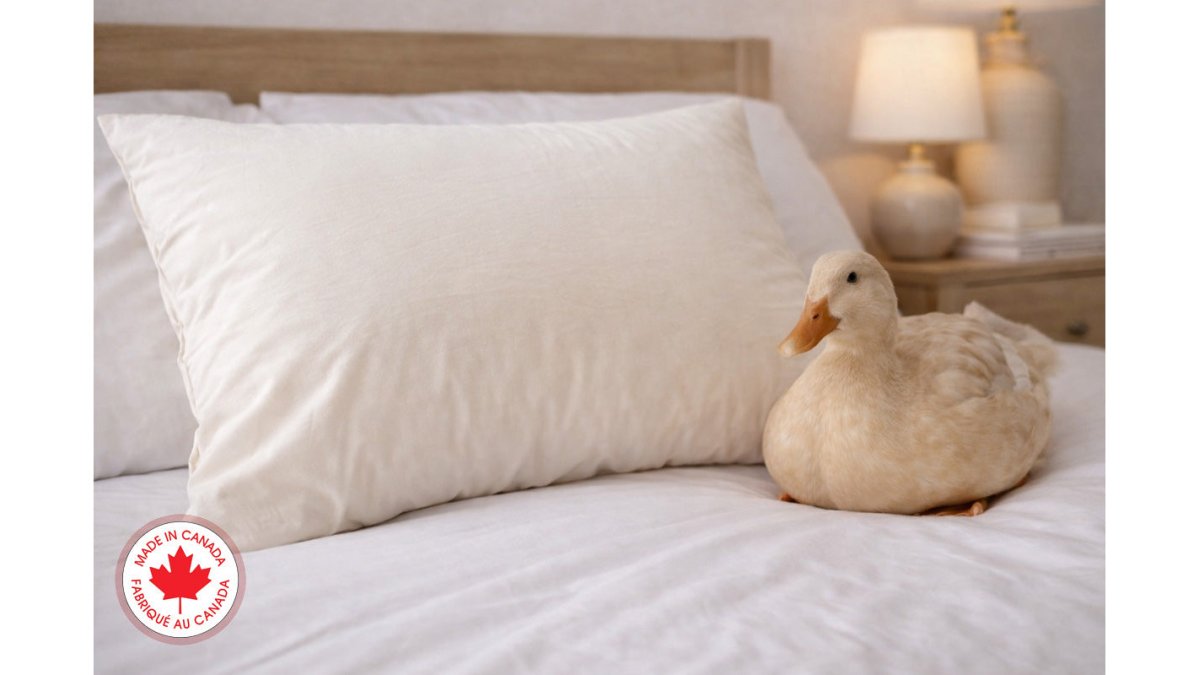
This blend is the classic construction for a reason.
How to Clean Down Pillows Without Flattening the Loft
Cleaning down pillows correctly is the single biggest factor in how long they last. Most pillows are ruined not by use but by improper washing and drying.
Follow this sequence:
- Check the shell for tears before washing; stitch any small openings first
- Use a front-loading machine on a gentle cycle with mild detergent
- Run an extra rinse cycle to remove all soap residue
- Tumble dry on low with two or three dryer balls to break up clumps
- Repeat the dry cycle until the pillow feels completely dry inside
- Air the pillow for a few hours before putting it back on the bed
Matching Fill and Firmness to Your Sleeping Position
The right pillow height depends almost entirely on how you sleep. A pillow that works for a back sleeper will feel wrong for a side sleeper, and vice versa. A back and a stomach sleeper may use the same pillow if the person is smaller. We measure our pillows in ounces used in the pillow and the loft it gives. We then sell these pillows to ppl based on their wight and shoulder size to make sure they get the pillow that’s right for them
Sleeping Position |
Recommended Firmness |
Why It Works |
|---|---|---|
Back sleeper |
light /Medium |
Supports the neck curve without pushing the head forward |
Side sleeper |
Heavy to Super. This depends on shoulder size and weight of customer |
Fills the gap between shoulder and head to keep the spine aligned so the shoulders do not support the head. |
Stomach sleeper |
light. we want to make sure you do not arch your neck |
Keeps the head low so the neck does not twist |
Combination sleeper |
it all depends on the wight of the customer and shoulder size. |
Handles position changes through the night |
Allergy Management, Dust Mites, and Sourcing Standards
Down pillows can trigger allergies, but the cause is usually dust mites and residual dust in poorly washed fill, not the down itself. Repeated washing during manufacturing removes most of the proteins and dust that cause reactions. This is why the wash count matters more than the word "hypoallergenic" on a label. We wash our pillow fill five times. That’s plenty and it’s done by ladies, artisans, who have done this for decades.
How to sanitize a down pillow without ruining the loft
Most guides stop at "wash it." Here is the full protocol that preserves loft while actually removing allergens:
- Check the shell for tears before washing; stitch any small openings first
- Use a front-loading machine on a gentle cycle with mild detergent, top-loaders with agitators can tear seams. Or take to Dry cleaners for a “ pillow washing”
- Run an extra rinse cycle to remove all soap residue; leftover detergent attracts dust
- Tumble dry on low with two or three dryer balls to break up clumps
- Repeat the dry cycle until the pillow feels completely dry inside, this can take two or three cycles
- Air the pillow, toss it in the sun on the patio table, for a few hours before putting it back on the bed, the sun is the best cleanser of all.
How to test whether your pillow is worn out
Pillows do not fail all at once. They lose loft gradually, and most people keep sleeping on a dead pillow for a year before noticing. Fold the pillow in half and press down. Release it. A pillow with life left springs back to shape within a few seconds. A pillow that stays folded has lost its cluster structure and should be replaced, or used for a smaller person like a child or as a body pillow. One of my pillows was made by my grandma when I was a child. It’s over 50 years old. Used only as a body pillow now. That shows how well a pillow can be made.
Sourcing, ethics, and the local advantage
Down and feather byproducts from food production are the standard source for bedding fill. Ethical sourcing standards focus on how birds are raised and handled, and buyers who care about this should ask where the fill comes from and how it was processed. A maker who can answer that question specifically is usually a maker who knows their supply chain. We deal with Hutterites. They farm for their own and their neighbours food production. The feathers are then used for pillows. Reuse recycle don’t use polyester don’t waste what God has given us, that is our and their moto.
Conclusion
Handmade duck down pillows made in Canada combine traceable materials, careful washing, and construction that holds up over years rather than months. The key decisions come down size and weight of the customer. For larger ppl with larger shoulders we provide more weight and more loft. For smaller ppl we use less. the down-to-feather ratio always remains 50/50, and we match pillow size and weight to your sleeping position and the person in front of us. A 50/50 blend with a 100% cotton shell covers most sleepers well, and proper washing and drying will keep the loft intact far longer than most people expect.
Frequently Asked Questions
What is the difference between duck down and duck feathers in pillows?
Down clusters are the soft, round filaments that trap air and create loft, while feathers are flatter with a quill that adds structure and resilience. A pure down pillow feels plush and compresses easily; a feather-heavy pillow feels firmer and holds its shape longer. Blends like 50% duck down and 50% duck feathers combine both, giving you cushioning on top with support underneath. That balance suits sleepers who find all-down pillows too soft and all-feather pillows too stiff.
Are handmade pillows better than mass-produced down pillows?
Handmade pillows are typically filled and sewn in smaller batches, which allows for more consistent fill distribution and closer quality checks. Grandma DeClercq's Duck Feather and Down Pillows are made in Manitoba with a 100% cotton shell, and the feathers and down are washed five times. That level of washing removes dust and irritants that can survive quicker industrial processing.
How do I care for my duck down pillow to ensure longevity?
Use a pillow protector to keep the cotton shell clean, and spot-clean small marks between washes. When it is time for a full wash, use a gentle cycle with mild detergent, then tumble dry on low with dryer balls to break up clumps and restore loft. Never dry clean down, and avoid high heat, which weakens the quills. Fluff your pillow daily and air it out monthly. A well-cared-for pillow can hold its loft for years rather than months.
Why choose locally made bedding products?
Local manufacturing shortens the supply chain, which makes it easier to verify materials and working conditions. It also supports regional jobs and reduces the transport emissions tied to imported bedding. For shoppers in Manitoba, buying locally means you can visit a showroom, feel the fill and firmness in person, and ask direct questions about construction. Grandma DeClercq's Duck Feather and Down Pillows, for example, are made in Manitoba by grandmas and their helpers, with a 120 day comfort guarantee and 3-year warranty.