

Mattress Warranty Coverage Explained: 2026 Guide
Table of Contents
- What Mattress Warranty Coverage Actually Includes
- Mattress Warranty Voiding Conditions to Avoid
- How to Measure Mattress Sagging for Warranty Claims
- The Mattress Warranty Claim Process in Canada
- Warranty vs. Sleep Trial vs. Protection Plan
- How to Handle a Denied Warranty Claim
- Frequently Asked Questions
Last Updated: September 16, 2026
What Mattress Warranty Coverage Actually Includes
Mattress warranty coverage explained in plain terms comes down to one distinction: the warranty protects you against defects in materials or workmanship, not against your mattress getting older. All warranties are limited warranties, you can’t use it as a trampoline for instance; typically covers manufacturing defects such as sagging beyond a stated depth, broken coils, or a broken side wall. While normal wear and tear falls outside its scope. Best Sleep Centre has handled warranty questions since 1993, and the pattern is always the same: claims succeed or fail on documentation, not on how strongly the customer feels about the mattress. The best way to avoid a warranty claim is to buy the right mattress in the first place. A 260 lb customer buying a 300.00 queen mattress will obviously ware it out long before the 125 lb customer buying the same mattress. At Best Sleep Centre we endeavour to match the customer in front of us with the quality they need OR we will tell you up front the mattress will wear out before the warranty period. That customer remains our friend and comes back when they wear out their lower price mattress. Warranty is for what new do wrong not how hard you drive the car.
Manufacturing Defects vs. Normal Wear
The line between a defect and normal wear is where most disputes begin. Manufacturing defects include faulty craftsmanship, material flaws, structural integrity failures, foam breakdown, and coil failure. Normal wear and tear includes gradual softening, minor indentations from body weight, and the sleep surface losing some of its initial loft. A warranty covers repair or replace remedies for the first category only. Understanding the difference before a problem develops saves considerable frustration later. Buying the highest foam density offered to you that you can afford from a salesperson who works with you specifically for a decent period of time will make sure you don’t have these wear problems in the future.*
The Law Tag: Your Proof of Purchase
That stiff tag sewn into the edge of the mattress is not decorative. It carries the model name, dimensions, and manufacture date, and it is often the single strongest piece of proof of purchase available. Keep it attached. Removing it can complicate a claim, and in some cases a missing law tag makes the model impossible to verify. Removing that tag voids the claim period with most if not all manufacturers.
Mattress Warranty Voiding Conditions to Avoid
Warranty voiding conditions are the small, ordinary habits that quietly cancel coverage. Stains and soil are the most common, because a soiled mattress cannot be inspected or repaired, so most warranties exclude it outright. It’s always coke but even coke can’t be taken into a sterile environment where new mattresses are made. To have warranty you must have a spotless mattress.
Accidental damage, burns, and cuts are excluded for the same reason. Using an improper mattress foundation, removing the law tag, or failing to follow the manufacturer's mattress care instructions can also void coverage. Rotate your mattress it adds years of life and don’t stand on it to change the light above the bed. Especially an all foam mattress.
Why Stains Void Coverage
A stain is not just cosmetic in warranty terms. It signals that liquid reached the foam or fiber layers, which can break down materials, encourage mold, and make the mattress unsafe to handle during inspection or repair. Because the manufacturer cannot verify what the mattress was exposed to, all warranties treat any stain as a disqualifying condition. Perspiration, spills, you enjoying each other’s company, pet accidents, and children's accidents all count.
A waterproof protector is the cheapest warranty insurance available. Best Sleep Centre stocks several options: One we stock is medical grade and guarantees you never loose your warranty due to the info above. Their warranty has conditions as well, all do but this medical grade mattress protector from PureCare is the best money can buy to avoid warranty problems later.
- OmniGuard Advance Total Encasement Mattress Protector Starting at $149.00, guards all six sides and conforms to Oeko-Tex Standard 100 certification.
- Organic Cotton Waterproof Mattress Protector at $259.00, GOTS-certified organic jersey cotton over a bio-based TPU layer.
- Health Comfort Total Encasement at $59.00, a lower-cost waterproof option that stretches over mattresses up to 18 inches thick.
Bed Frame and Foundation Requirements
Every warranty names a required foundation, and ignoring it is one of the quietest ways to lose coverage. A sagging or unsupportive bed frame transfers stress to the mattress and creates the exact sagging pattern that manufacturers attribute to improper support. Slats must be spaced correctly, centre supports must be present on larger sizes, and a box spring must match the mattress type. Many warranties make you buy a boxspring even for your platform bed. We do not but the salts must be 10 minimum and not flex when pressure is applied. If the slats flex the whole mattress does the same and this action tears the foam over and over again.


The Law Tag and Care Instructions
Removing the law tag can complicate a claim because the model and manufacture date become impossible to verify. Follow the manufacturer's care instructions as well, rotating the mattress on schedule, using the recommended foundation, and avoiding folding or bending the mattress all fall under the care terms most warranties require.
How to Measure Mattress Sagging for Warranty Claims
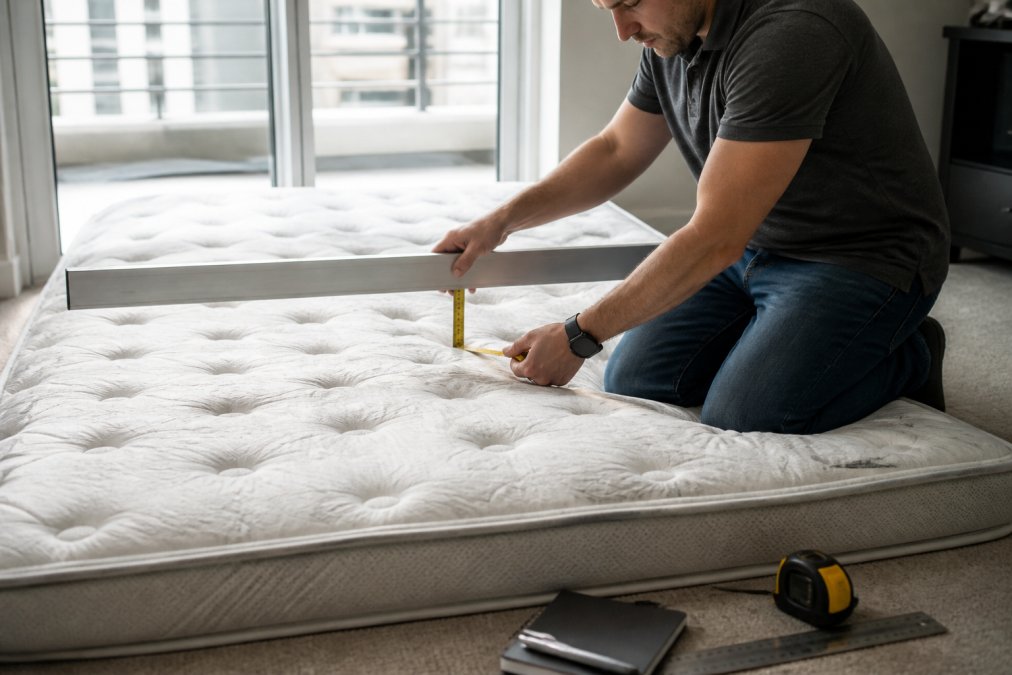
Measuring sagging correctly is the step most claims get wrong. Lay a straight edge, such as a long ruler or a taut string, across the sagging area and measure the gap between the straight edge and the lowest point of the sleep surface. Photograph the straight edge in place with the tape measure visible in the same frame. Do this on a flat, firm floor with the mattress removed from the bed frame, and repeat the measurement in more than one spot. But do not measure in the original stitching present on the day of purchase. That does not count.
The Mattress Warranty Claim Process in Canada
The mattress warranty claim process in Canada runs through the retailer or the manufacturer named on the warranty card, and it is almost entirely a paperwork and inspection exercise. Consumer rights around written warranties fall under provincial consumer protection legislation, and each province sets its own rules on disclosure, remedies, and timelines. Start by locating your proof of purchase, the law tag details, and your original delivery paperwork, then contact the point of sale before contacting the manufacturer directly; The manufacturer will not deal with a retail customer in most cases. and the forms on the retailers websites must be filled out the retailer usually holds the claim record and can move it faster.
Documentation and Photographic Evidence
A complete claim package includes the original receipt, the model and law tag information, dated photographs of the defect with a measuring tool in frame, and a written description of when the problem appeared. Photographic evidence should show the whole mattress, not just the sagging area, so the inspector can confirm the foundation and setup. Keep copies of everything you send. For the last 20 years warranty is self done over the internet. There are no home inspections, it’s easy to prove a real warranty issue with Best Sleep Centre. Simply follow the direction in the warranty link.
Claim Step |
What You Need |
Typical Timing |
|---|---|---|
Notify the retailer |
Receipt, law tag details |
As soon as the defect appears |
Submit documentation |
Photos with measurement, written description |
With the initial claim |
Inspection process |
Access to the mattress and foundation |
Scheduled by the retailer |
Decision and remedy |
Repair or replace, shipping costs confirmed |
After inspection |
What the Inspector Actually Checks
if an inspector is sent out he or she is not there to judge how the mattress feels. The visit is a verification exercise with a short checklist: the law tag is present and matches the receipt, the foundation matches the warranty requirement, the sag measurement clears the stated threshold, and the surface shows no stains or soil. A claim often fails at one of those four points rather than on the defect itself, which is why the documentation stage matters more than the complaint.
Retail Purchase vs. Online-Only Purchase
The purchase channel changes how a claim unfolds, and this is the part most guides skip.
- Retail store with a physical showroom:, store staff can advocate on your behalf once documentation has been sent and the foundation and frame setup can be verified via photos .This is the smoother path.
- Online-only purchase: you are often responsible for shipping the mattress back at your own cost, and shipping is frequently excluded from coverage. Some online sellers require you to photograph the mattress in a specific way or complete a self-inspection form before they will open a claim. These mattress are normally all foam ir maybe Hybrid. The fail in support and firmness but they never loose their shape. You seldom if ever get warranty on these types of products. you simply can’t sleep any more
If the Claim Stalls
A claim that goes quiet is not a closed claim. Follow up in writing, reference your claim number, and ask for the next step in the process rather than repeating the original complaint. If the retailer stops responding, contact the manufacturer named on the warranty card directly and copy the retailer. Keep every phone call and email in one timeline so the sequence is easy to reconstruct.
Warranty vs. Sleep Trial vs. Protection Plan
A warranty is generally non-transferable and applies only to the original purchaser, which matters if you sell or gift the mattress later. Prorated coverage, where the manufacturer's contribution shrinks as the mattress ages, is common in the later years of a warranty period. Ask whether your coverage is full or prorated before you assume a replacement is free.
How to Handle a Denied Warranty Claim
A denial is not always final. Ask for the specific reason in writing, then check it against the warranty document yourself. Most denials cite one of four things: stains or soil, an unsupported foundation, body impressions below the stated threshold, or a missing law tag. If the reason is a measurement dispute, send better photos that show your case. If the reason is documentation, supply the missing proof of purchase and resubmit.
Frequently Asked Questions
What is covered by a mattress warranty?
A mattress warranty typically covers manufacturing defects such as faulty craftsmanship, material flaws, and structural integrity issues like foam breakdown or coil failure. It does not cover normal wear and tear, stains, or accidental damage. Most warranties require the original purchaser and proof of purchase. Coverage periods vary, and many include prorated coverage after an initial full-replacement window. Always check the specific terms of your mattress warranty before filing a claim.
What voids a mattress warranty?
Common mattress warranty voiding conditions include stains, soil, burns, and accidental damage. Using an unsupportive bed frame or foundation also voids coverage, as does removing the law tag. Many warranties require a mattress protector to keep the sleep surface clean. Failure to follow care instructions or using the wrong foundation can lead to a denied claim. Review your warranty terms carefully to avoid voiding the warranty.
Is a sagging mattress covered under warranty?
Sagging is covered only if it exceeds the warranty's specified sagging depth, often 1 to 1.5 inches. To file a claim, you must measure the indentation accurately using a straight edge and ruler. Normal wear and tear that does not meet the threshold is not covered. If you suspect a manufacturing defect, document the sag with photographs and contact the retailer or manufacturer for an inspection process.
How do I file a successful mattress warranty claim?
Start by locating your proof of purchase and the law tag. Measure any sagging and take clear photos. Contact the retailer or manufacturer to initiate the mattress warranty claim process in Canada. Provide all required documentation, including photographic evidence. If the claim is denied, ask for the reason in writing and request a review. Keep records of all communication and consider the repair or replace options offered. IN THE END You don’t want a warrant claim at all you want to buy from a company thats products in 99.8 percent of the cases don’t need to make a warranty claim. Thats Best Sleep Centre. many many many thousands of mattresses sold over the years and less than 2 claims a month over a ten year period. Most months none at all and when ppl do claim. We go bobber and above whenever possible to get them sleeping again: because thats the real issue.