

Solid Wood Dining Sets for Everyday Use: A Buying Guide
Last Updated: November 21, 2026
Quick Summary
Solid wood dining sets for everyday use are built from real hardwood, sized for daily family meals, and finished to handle spills and repeated cleaning. The sets that hold up best share honest hardwood construction, a shape that fits the room, and a finish that tolerates real life.
- Allow 90 cm of clearance on every side of the table that has a chair.
- Allow about 60 cm of table edge per person when sizing seating capacity.
- A bench tucks fully under the table and saves clearance on one side.
- Wipe spills promptly with a barely damp cloth and dry immediately.
- Avoid ammonia-based cleaners and abrasive pads, which dull the finish.
Table of Contents
- What Makes a Solid Wood Dining Set Right for Everyday Use
- Dining Table Wood Types Compared for Daily Wear
- Solid Wood, Veneer and Engineered Wood: What You Are Actually Buying
- Sizing and Clearance: Matching the Set to Your Room and Family
- Why an Extendable Solid Wood Dining Table Earns Its Space
- Solid Wood Dining Table Care, Cleaning and Repair
- Choosing Your Solid Wood Dining Set at Best Sleep Centre
- Frequently Asked Questions
What Makes a Solid Wood Dining Set Right for Everyday Use
Solid wood dining sets for everyday use are tables and seating built from real hardwood, sized for daily family meals, and finished to handle spills, homework, and repeated cleaning. At Best Sleep Centre, the dining sets that hold up best share three traits: honest hardwood construction, a shape that fits the room, and a finish that tolerates real life.
The difference between a set that lasts and one that wobbles by year three rarely comes down to style. For a closer look at why solid wood furniture lasts and is worth the investment, read the full article. It comes down to what sits under the tabletop and how the joints are built.
Below, this guide breaks down wood species, construction types, sizing, extendable options, and care, so the choice is made on facts rather than showroom lighting. The five sections that follow cover what actually matters at the dinner table.
Dining Table Wood Types Compared for Daily Wear
Hardness and grain stability decide how a wood species ages under daily use. Oak, walnut, ash, and birch each behave differently at the dinner table, and the differences show up in dents, scratches, and how often the finish needs attention.
A useful way to compare them is on four practical axes: how hard the surface is, how well the grain hides wear, how much maintenance the finish needs, and how the species moves with seasonal humidity. Most furniture makers group hardwoods by density because denser wood resists dents from dropped cutlery and shifted chairs, while open-grained species camouflage small scratches better than tight-grained ones.
Oak is the workhorse. Its open grain hides small scratches well, and the tight, interlocking fibers resist dents from dropped cutlery. White oak in particular takes stain evenly and holds a finish for years. Red oak is slightly more porous and shows a coarser grain, which suits rustic looks. Both are heavy, so a large oak table is best moved with help.
Walnut is softer than oak but richer in tone. It shows wear more readily, so it suits households past the toddler stage or tables that get a protective pad during crafts. Walnut's straight grain takes a hand-rubbed oil finish beautifully, but oil finishes need reapplication more often than a factory lacquer.
Ash shares oak's hardness with a straighter, more contemporary grain. It takes light finishes beautifully, which suits Scandinavian Oak and similar pale looks. Ash is also a good choice where a pale, uniform surface is wanted without the pronounced ray fleck of quarter-sawn oak.
Canadian birch sits in the middle: hard enough for daily plates and glasses, warm in color, and often more affordable than walnut. Birch takes stain less evenly than oak, so a clear or light finish usually looks better than a dark stain.
A common mistake is choosing purely on color. The grain pattern and hardness matter more once the table is in daily rotation. A softer species with a protective pad and coasters often outlasts a harder species left bare.
Watch out: judging a species by a small showroom sample under warm lighting. Ask to see a larger panel and, where possible, a finished table, because grain and color read very differently at full scale.
Learn more about the value of handcrafted wooden furniture in this buyer's guide.
Solid Wood, Veneer and Engineered Wood: What You Are Actually Buying
Solid wood means the boards are cut from a single piece of timber through their full thickness. Veneer is a thin slice of real wood glued over a core of plywood or particle board.
The durability guide for Amish hardwood furniture explains how construction quality shows up over years of use.
Sizing and Clearance: Matching the Set to Your Room and Family
Measure the room, then measure the walkway, and only then pick a set size. Most dining rooms fail on clearance, not on table size.
Start with the table footprint and add 90 cm of clearance on every side that has a chair. That space lets someone push back and stand without hitting a wall or sideboard. For a walkway behind seating, allow closer to 110 cm.
Seating capacity follows the table length. As a working rule, allow about 60 cm of table edge per person. That puts a comfortable four-person table around 120 cm, six around 180 cm, and eight around 240 cm.
| Household Size | Table Length | Typical Set | Room Footprint Needed |
|---|---|---|---|
| 2-4 people | 120 cm | Three-piece set | About 3 m x 3 m |
| 4-6 people | 180 cm | Five-piece set | About 3.3 m x 3.6 m |
| 6-8 people | 240 cm | Seven-piece set | About 3.6 m x 4.2 m |
Bench seating saves clearance on one side because a bench tucks fully under the table. Round tables work well in square rooms and small kitchens, while rectangular tables suit long rooms and formal dining spaces.
Why an Extendable Solid Wood Dining Table Earns Its Space
An extendable table gives a small everyday footprint and a large entertaining footprint from the same piece. That flexibility is why extendable designs earn their place in condos and family homes alike.
The mechanism is the part to inspect. A well-built extension glides on solid tracks and locks firmly, with no sag in the middle leaf. Ask how the table extends: butterfly leaves fold from the center, while separate leaves store elsewhere.
For a round option, the Transformer Round Dining Set - The Gathering seats up to 10 guests and is built from solid wood with an extension mechanism.
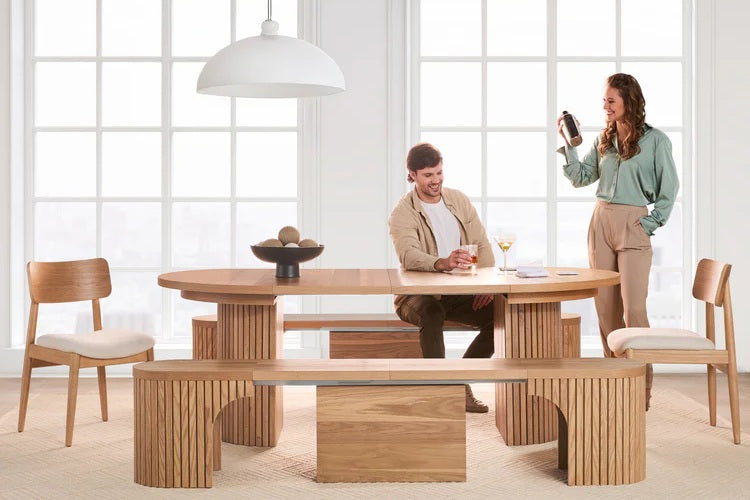
Extendable sets also solve the seating-capacity problem without a second table. A set that seats four on a Tuesday can seat eight or more on a birthday, which is a better use of floor space than a permanently large table.
Solid Wood Dining Table Care, Cleaning and Repair
Daily care is simple: wipe spills promptly, dust with a soft cloth, and keep the table out of direct sun and away from heat vents. Water rings and heat marks come from moisture and temperature, not from the wood itself.
A workable routine is daily, weekly, and seasonal. Daily, wipe crumbs and spills with a soft, barely damp cloth and dry immediately. Weekly, dust the whole surface and the chair rails with a microfiber cloth, and check under coasters and centerpieces for trapped moisture. Seasonally, inspect the finish for dull spots, tighten any bolts or leg hardware, and treat minor dryness according to the finish type.
For routine cleaning, use a barely damp cloth with a mild soap solution, then dry immediately. Avoid ammonia-based cleaners and abrasive pads, which dull the finish. Never flood the surface; moisture that sits at a seam or edge is what causes swelling and white marks.
Finish type changes the care. A factory lacquer or polyurethane finish is the most forgiving and usually needs only damp wiping. An oil or wax finish looks richer but needs periodic reapplication, and it shows water marks more readily until it is refreshed. If the finish is oil-based, a thin coat of furniture oil followed by a buff with a dry cloth restores sheen; if it is lacquer, leave re-coating to a professional.
Seasonal movement is normal in solid wood. Indoor humidity swings cause the tabletop to expand and contract slightly across the grain, which is why well-built tables use floating tops or slotted fasteners. Keep indoor humidity reasonably stable, and expect small gaps or slight movement at breadboard ends rather than treating them as defects.
Repair is where solid wood shines. Light scratches often disappear with a matching touch-up marker or a wax stick. Deeper scratches and worn spots can be sanded and refinished, sometimes decades later, because the wood runs through the full thickness. Dents can sometimes be raised with a damp cloth and a warm iron, but test on a hidden area first.
Watch out: leaving a wet glass or a hot serving dish directly on the table is the fastest way to a permanent ring or white heat mark. Use coasters and trivets every time.
A washable table pad protects the surface during crafts and holiday meals without hiding the grain the rest of the year. For chairs, check leg glides and tighten hardware as part of the same seasonal routine, since loose joints and worn glides are what let a set wobble over time.
Choosing Your Solid Wood Dining Set at Best Sleep Centre
Start with the room measurements and the household size, then match the set to both. Best Sleep Centre carries extendable dining sets built for daily use, with finishes that range from Scandinavian Oak to American Walnut.
The Transformer Indoor Dining Set - The Practical seats between 2 and 12 people and comes in Scandinavian Oak, Smoked Hickory, American Walnut, or Canadian Birch. Its matching bench tucks away when not in use.
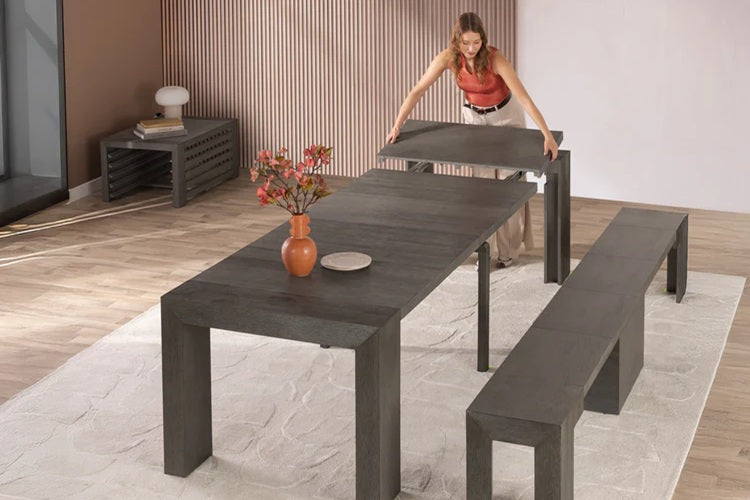
For a larger gathering table, the Transformer Indoor Dining Set - The Gathering seats 2 to 12 with expandable benches that slide under the table. The Host set adds stackable chairs for a similar flexible footprint.
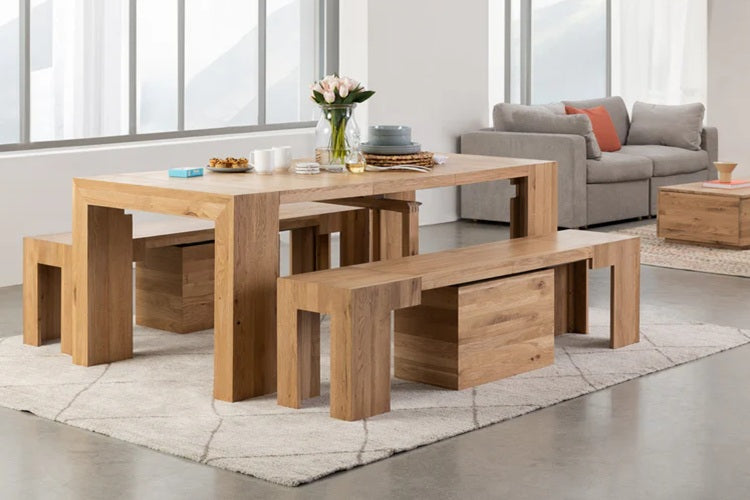
These solid wood dining sets are built from quality wood with extension mechanisms and a space-saving design for condos and family homes.
Frequently Asked Questions
Are solid wood dining tables good for everyday use?
Yes, when the construction suits daily wear. Look for a hardwood frame, a stable tabletop and a finish that resists moisture. Families who eat at the table three times a day put more stress on it than occasional entertainers, so weight and joint quality matter as much as the wood species.
Which wood is best for a dining table used every day?
Hardwoods such as oak, walnut, ash and birch handle daily use well because they resist dents and hold screws and joints firmly. Oak is the most forgiving for busy households, walnut brings a darker tone and a dense surface, and ash offers a light grain with good shock resistance. Softer woods mark more easily under cutlery and toys. Whichever you pick, the finish and construction decide how well the table survives everyday meals.
How do you protect a solid wood dining table from scratches and spills?
Use coasters under hot drinks, felt pads under anything that slides, and wipe spills promptly with a damp cloth rather than letting liquid sit. A washable tablecloth or placemats take the daily abuse during crafts and homework. Reapply a quality furniture wax or oil a few times a year depending on the finish, and keep the table out of direct sun so the wood grain fades evenly. Deep scratches can be sanded and refinished on solid wood.
What size dining table do I need for my family?
Allow roughly 60 cm of table edge per person and at least 90 cm of clearance around the table for chairs to pull out. A family of four fits comfortably at a rectangular table around 150 cm long, while six needs closer to 180 cm. If your room is tight or your guest list changes, an extendable solid wood dining table lets you keep a compact footprint day to day and open up for holidays. Measure the room before you shop.
